
Living With Braces
Medically Reviewed by Dr. Duane S. Shank, DDS, Board-Certified Orthodontist
Braces change four everyday things: how you brush, what you eat, how your teeth feel for a few days after each adjustment, and what you do when something comes loose. None of it is difficult, and all of it becomes automatic within about two weeks. Here is the practical version.
The first week
Your teeth will be tender for three to five days after the braces go on, and briefly after each adjustment. It is pressure rather than pain, it responds to whatever you normally take for a headache, and it fades on its own.
Lips, cheeks, and tongue need one to two weeks to toughen up against the brackets. Orthodontic wax is for exactly this: dry the bracket, pinch off a piece, press it on. We give you a supply and you can ask for more at any appointment.
Soft food helps for the first day or two. By the end of the week most patients have forgotten the braces are there.
If discomfort is significant rather than mild, call us. Pain during treatment is not something to tough out.
Brushing and flossing
This is the part that actually matters, and it is the part patients most often let slide.
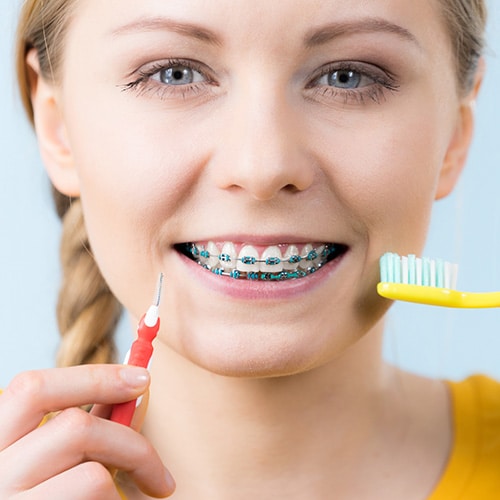
Brush after every meal and before bed, angling the brush above and below the brackets as well as across them. Two minutes, properly. Brackets create dozens of new places for plaque to sit, and plaque left around a bracket for two years leaves a permanent white mark on the enamel.
Floss daily with a threader or a water flosser. Fiddly for the first week, quick after that.
Keep your regular checkups with your own dentist throughout treatment, and see a periodontist too if you have a history of gum disease.
Eating with braces
The rule is simple: nothing hard, nothing sticky, and nothing you have to bite into whole.
Avoid ice, hard candy, nuts, popcorn (kernels especially), bagels and hard rolls, caramels, licorice, and chewing gum. Corn comes off the cob, apples and carrots get sliced, and pizza crust gets torn rather than bitten.
Chewing on pens, pencils, and fingernails does the same damage more slowly and accounts for more broken brackets than most patients would guess.
Every broken bracket adds time to treatment. That is the honest reason for the food rules, and it is more persuasive than anything else we could say.
Feeling self-conscious about it
Worth saying, because people rarely ask out loud.
Most patients feel more visible in the first two weeks than they ever do again, and most report that other people notice far less than they expected. Ceramic brackets are an option if the appearance is genuinely going to bother you, and roughly one in three orthodontic patients today is an adult, so you are in more company than you think.
Loose teeth, loose wires, and other normal things
Teeth feel slightly loose during treatment. This is expected and it is how tooth movement works. They firm up in their new positions once treatment finishes and retainers take over.
A wire has come loose or is poking. Push it back under the archwire with the eraser end of a pencil, or cover it with wax. If it still catches, call us during patient hours.
A bracket or band has come loose. Leave it in place, cover it with wax if it rubs, and call. It can nearly always wait until an appointment.
The full triage guide, including what to do after an injury to the mouth, is on the orthodontic emergencies page.
Sports and instruments
Tell us what you play. For contact sports we provide a mouthguard that fits over the braces, and it is the single best protection against turning a bracket problem into a tooth problem.
Wind and brass players take a couple of weeks to adjust, and wax over the front brackets helps during that period. Everything else carries on unchanged.
Elastics and cooperation
If Dr. Shank prescribes elastics, wear them exactly as instructed. Teeth and jaws move toward their corrected positions only while the prescribed forces are actually applied, and elastics are the part of the plan that depends entirely on the patient.
Consistent wear finishes treatment on schedule. Inconsistent wear adds months. That really is the whole equation.
Questions between appointments
Call (631) 265-3666. Nothing is too small to ask about.
Smithtown Orthodontics 200 E Main St. Smithtown, NY 11787 (631) 265-3666
Questions about life with braces
What is the hardest week of braces?
The first one. Teeth are tender for three to five days after placement, and the cheeks and lips take one to two weeks to toughen against the brackets. After that, most patients describe treatment as unremarkable, with a day or two of mild pressure following each adjustment.
How long are teeth sore after braces are tightened?
Usually one to three days, and less than after the initial placement. It feels like pressure rather than sharp pain. Soft food and an ordinary over-the-counter pain reliever handle it. If soreness lasts beyond about five days or is severe, call the office.
What foods should I avoid with braces?
Anything hard, sticky, or requiring a whole-mouth bite. That means ice, hard candy, nuts, popcorn, bagels and hard rolls, caramels, licorice, and gum. Corn goes off the cob, apples and carrots get sliced. Chewing pens and fingernails counts too, and breaks more brackets than most people expect.
How often should I brush with braces?
After every meal and before bed, for a full two minutes, angling the brush to reach above and below each bracket. Floss daily with a threader or a water flosser. Plaque left sitting around brackets can leave permanent white marks on the enamel after the braces come off.
Is it normal for teeth to feel loose during treatment?
Yes, and it is a sign treatment is working. Teeth must loosen slightly in order to move through bone. They firm up in their corrected positions once the braces come off and the retention phase begins.